The badge on the left is a brass St John Ambulance Association First Aid Medallion, with a 1960 label. The badge on the right is a Home Nursing pendant.
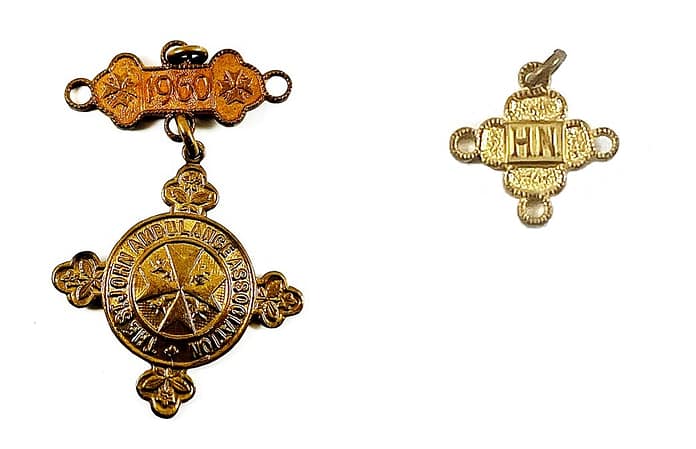
The first aid medallion was authorized in 1879 and first awarded in 1881. It was discontinued in 1992. The design changed several times – initially it featured a plain cut-out cross, which was changed to an eight-pointed cross in 1884. After the Royal Charter of 1888, Royal beasts were added to the cross. The medallion was available in two sizes (24 mm or 40 mm) in brass, silver, or gold (depending on how much the awardee was willing to pay). Purchasing one was entirely optional. Medallions were engraved on the back with the recipient’s name and the medallion certificate number.
Initially, the medallion was awarded after passing three examinations in first aid (i.e. obtaining the first aid certificate for the third time). From 1905, this was amended – two of the three exams were to be first aid, but the third one could be one of the other Association certificates (Home Nursing, Home Hygiene, Sanitation, or Child Welfare).
From 1905, a label was awarded for each year that a first aid re-examination was passed after gaining the medallion (the label shown above is from 1960, so presumably the medallion was awarded in 1959). Some examples show multiple labels all joined together (occasionally 20 or more!)
Pendants were introduced in 1916. The example shown above is Home Nursing (HN). Other options were Home Hygiene (HH), Sanitation (S), and from 1944 Child Welfare (CW). Pendants were connected in chronological order between the labels.
Those who wore their medallion were rightly proud of the knowledge and skill that it represented.
Reference
Gould R. St John Ambulance Association First Aid Re-Examination Medallion, Orders and Medals Research Society, Wellington Branch Booklet No 6, 2003.